News
– The company participated in the 19th edition of the leading international forum on anaerobic technologies, held in Valencia from June 9 to 13, with the coordination of a strategic workshop and the presentation of multiple innovation projects
– The presentation on the production of medium-chain fatty acids from wine waste, within the CIGAT Circular project and delivered by Celia Castro, won the award for best oral presentation at the Congress ex aequo
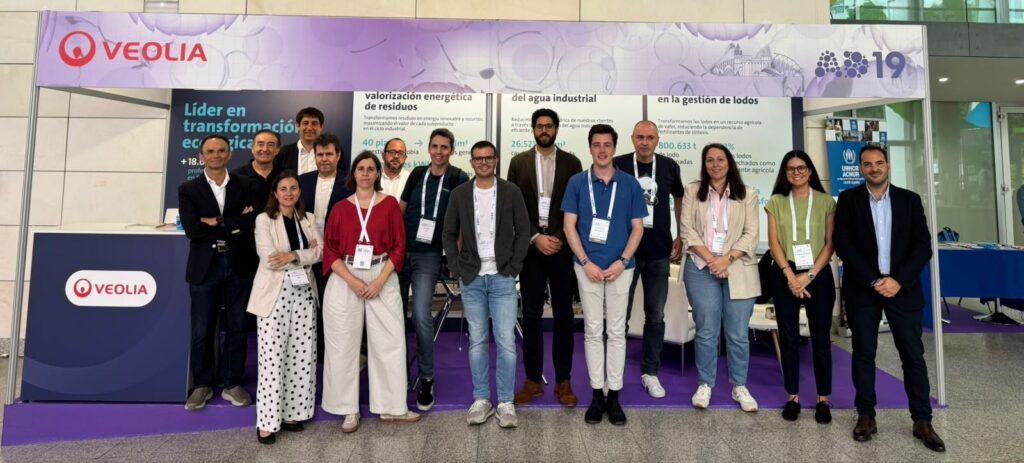
Veolia participated in the 19th World Conference on Anaerobic Digestion of the International Water Association (IWA AD19), held in Valencia from 9 to 13 June 2026 under the theme “Fueling Sustainability”. The congress was one of the leading international meetings dedicated to anaerobic technologies and brought together the scientific, technical and institutional community of the sector to explore the latest advances in a key field for the transition towards a circular water management model.
Veolia’s participation was channelled through Cetaqua, its water technology centre, alongside the presence of local agents such as Aigües de Barcelona and Aguas de Alicante. This collaboration reflected a shared conviction in the spirit of the congress: anaerobic digestion has ceased to be a waste treatment solution to become a central technology in the transformation of wastewater treatment plants into circular platforms capable of recovering resources and generating energy.
El grupo ha coordinado, en el marco del congreso, el workshop “Utilities of the future – Towards Circular and Energy-Positive Water Utilities”, un espacio de trabajo dedicado a explorar el papel de la digestión anaerobia como tecnología vertebral en la evolución de las estaciones depuradoras de aguas residuales hacia plataformas de servicios circulares.
The group coordinated, within the framework of the congress, the workshop “Utilities of the future – Towards Circular and Energy-Positive Water Utilities”, a working space dedicated to exploring the role of anaerobic digestion as a backbone technology in the evolution of wastewater treatment plants towards circular service platforms.
The session, moderated by Celia Castro, head of the Zero Waste and Decarbonisation area at Cetaqua, addressed the scaling up of advanced models based on reference cases from Spain and the United States, analysing the technical, regulatory and social enablers necessary for energy production and resource recovery. María Muñoz, director of the Water Technical Department at Veolia in Spain, presented the paradigm shift involved in the transition from the concept of wastewater treatment plant to that of circular infrastructure, and Irene García, director of biosolids at the Water Technical Department at Veolia in Spain, presented the case of the Copero Complex as a prominent example of this transformation. The programme was completed with contributions from Aigües de Barcelona on innovative sludge management strategies and from Aguas de Alicante on advanced co-digestion, together with international experience from the San José–Santa Clara regional treatment plant in California.
El workshop ha culminado con una mesa redonda dedicada a posicionar las depuradoras urbanas como agentes clave en la producción de biogás y en el despliegue de la Hoja de Ruta del Biogás en España. El debate, moderado por Celia Castro, ha contado con la participación de María Muñoz, María Casanova (DAQUAS) y Andrea López (NILSA), y se ha centrado en las condiciones regulatorias, institucionales y de gobernanza necesarias para escalar la codigestión anaerobia desde casos aislados hacia un modelo replicable que integre los distintos flujos orgánicos del territorio. La discusión ha abordado igualmente la necesidad de armonizar el marco normativo entre comunidades autónomas y de coordinar los sectores del agua, la energía y los residuos para avanzar hacia la neutralidad climática.
The workshop culminated with a round table dedicated to positioning urban wastewater treatment plants as key agents in biogas production and in the deployment of Spain’s Biogas Roadmap. The debate, moderated by Celia Castro, featured the participation of María Muñoz, María Casanova (DAQUAS) and Andrea López (NILSA), and focused on the regulatory, institutional and governance conditions necessary to scale up anaerobic co-digestion from isolated cases towards a replicable model that integrates the various organic flows of the territory. The discussion also addressed the need to harmonise the regulatory framework across autonomous communities and to coordinate the water, energy and waste sectors to advance towards climate neutrality.
Beyond the workshop, Veolia, together with Cetaqua, presented throughout the congress a broad portfolio of innovation projects that illustrate the potential of anaerobic technologies to transform water and resource management. Among the oral presentations, work on biogas improvement through ex situ biological methanation and the analysis of biomethane commercialisation models stood out, within the framework of the SEMPRE-BIO and LIFE NIMBUS projects, and the selective recovery of metals from mining acid drainage through anaerobic membrane bioreactors, within the framework of the RESiLEX project, both presented by Alejandra Córdova, head of the Decarbonisation Technologies and Gas Valorisation programme at Cetaqua. The presentation on the production of medium-chain fatty acids from wine waste, within the CIGAT Circular project and delivered by Celia Castro, won the award for best oral presentation at the Congress ex aequo.
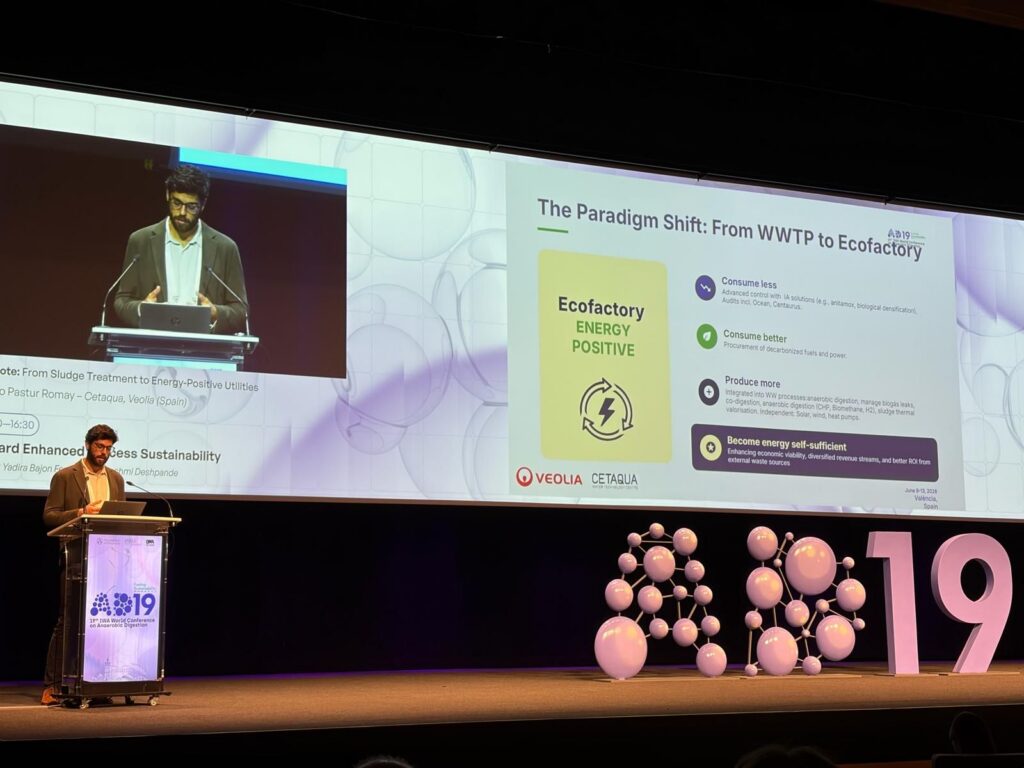
Additionally, Cetaqua delivered a keynote presentation by Mateo Pastur, head of Technical Strategy, on the evolution from sludge treatment towards energy-positive infrastructure, delving into the advancement of biogas production in wastewater sanitation infrastructure.
Cetaqua’s presence was completed with the presentation of several scientific posters focused on the transformation of wastewater treatment plants into eco-factories through the production of phosphate salts with agronomic value (NPower project), the combination of sludge pre-treatment and intelligent anaerobic co-digestion to drive electrical self-sufficiency of treatment plants (LIFE MERLIN project) and operational strategies for the safe transition from mesophilic to thermophilic anaerobic digestion (PONTE project).
Veolia’s participation in IWA AD19 has reaffirmed the company’s leadership in the ecological transformation of the water cycle and in the development of solutions that convert wastewater into a source of energy and material resources. Through anaerobic digestion and advanced co-digestion, Veolia promotes a wastewater treatment plant model that produces renewable energy, recovers nutrients and valuable materials and actively contributes to the decarbonisation of territories, aligning with the objectives of the Biogas Roadmap and climate neutrality.