
News
– The European project MULTIPLY brings together 17 partners to develop microalgae-based alternatives for everyday products, aiming to reduce reliance on fossil and food-based resources
The MULTIPLY project, funded by the European Union’s Horizon Europe programme, brings together partners from across Europe to develop and scale 10 microalgae-based solutions for five industrial sectors. By replacing fossil- and food-based ingredients with bio-based ingredients, the project aims to reduce the environmental footprint of everyday products and bring algae-based alternatives to market.
Working with five microalgae species—diatoms, Arthrospira (spirulina), Tetraselmis, Nannochloropsis and Chromochloris zofingiensis—MULTIPLY is developing products that demonstrate how algae can be a high-value product for different sectors, including:
• Food: natural colours and protein-rich ingredients.
• Feed: a salmon feed component enriched with microalgae compounds.
• Cosmetics: personal-care oils and esters.
• Lubricants: bio-based esters replacing conventional product oils.
• Biomaterials & packaging: compostable films, paper coatings and other packaging solutions based on oils and starch.
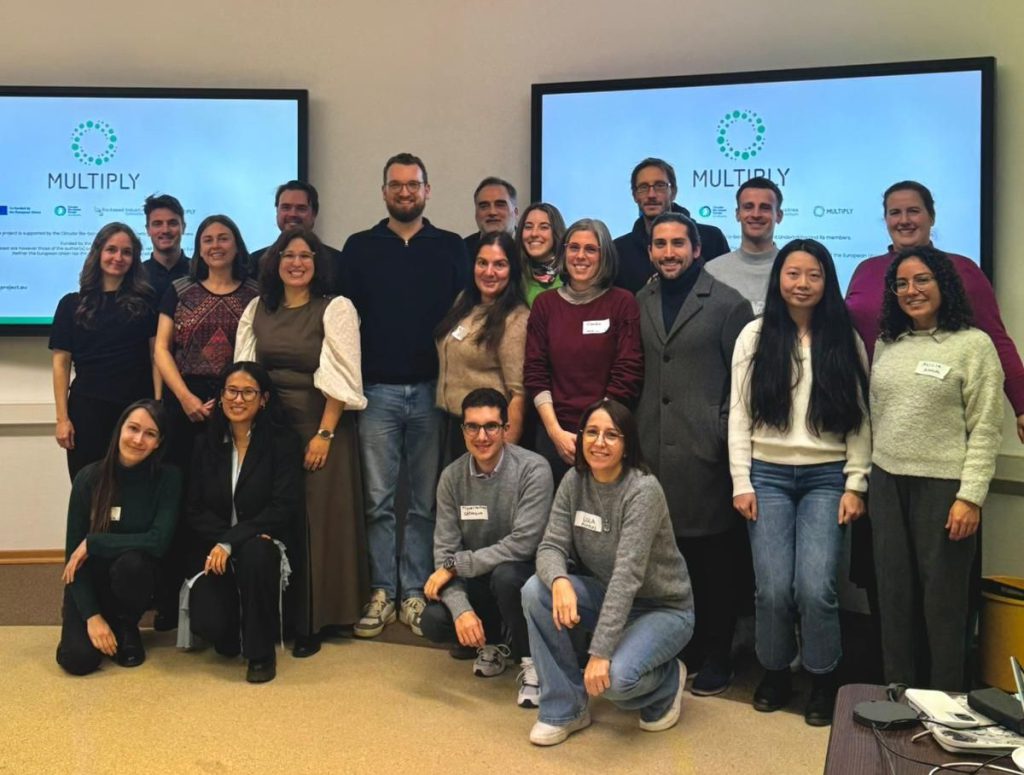
“Microalgae powering a circular future sums up our approach,” says project coordinator Marta Paiva from A4F, during the latest project meeting held in Berlin. “We focus on specific products and sectors where algae can realistically replace conventional raw materials, backed by technical, sustainability and scalability data.”
From Cetaqua-Water Technology Centre, work will be carried out with innovative technologies to recover nutrients (nitrogen and phosphorus) from urban and industrial wastewater and reuse them in microalgae cultivation.
With this objective, Cetaqua will lead three pilot plants: two at wastewater treatment plants (WWTPs) operated by Veolia in Murcia and Ourense, to recover phosphorus and ammonium salts respectively, and a third in Lisbon, aimed at transforming recovered ammonium into nitrate, a compound particularly suitable for microalgae cultivation.
Miguel Martínez, Project Manager and researcher at Cetaqua, highlights the benefits of this circular approach: “At Cetaqua, we work to demonstrate that wastewater is not waste, but a source of resources. With nutrient recovery, we reduce dependence on conventional fertilisers, advancing towards more sustainable production models, with lower environmental impact and aligned with circular economy principles.”
In the coming months, MULTIPLY will also test a new digital monitoring tool and deliver the first algae extracts and oils for product development, key steps to bring algae-based solutions to market. At the same time, sustainability and market acceptance studies will be deepened to prepare the ground for future algae-based products.
Learn more about MULTIPLY on its website
The MULTIPLY project is driven by a consortium of 17 entities combining scientific, technological and industrial capabilities: AlgaFuel, SA (coordinator), Cetaqua, Green Aqua Póvoa. SA, Swedish Algae Factory, Algiecel, FRAUNHOFER GESELLSCHAFT ZUR FOERDERUNG DER ANGEWANDTEN FORSCHUNG E.V. (IPK), Universidade NOVA de Lisboa, Instituto de Biologia Experimental e Tecnológica, GRA Nutra, SA, Edonia, Oleon, Novamont, AIMPLAS – Asociación de Investigación de Materiales Plásticos y Conexas, Nofima AS, Aalborg University, Luxembourg Institute of Science and Technology and SUBMARINER Network.
The opinions and documentation provided in this publication are the sole responsibility of the author(s) and do not necessarily reflect the views of the entities that financially support the project.