
News
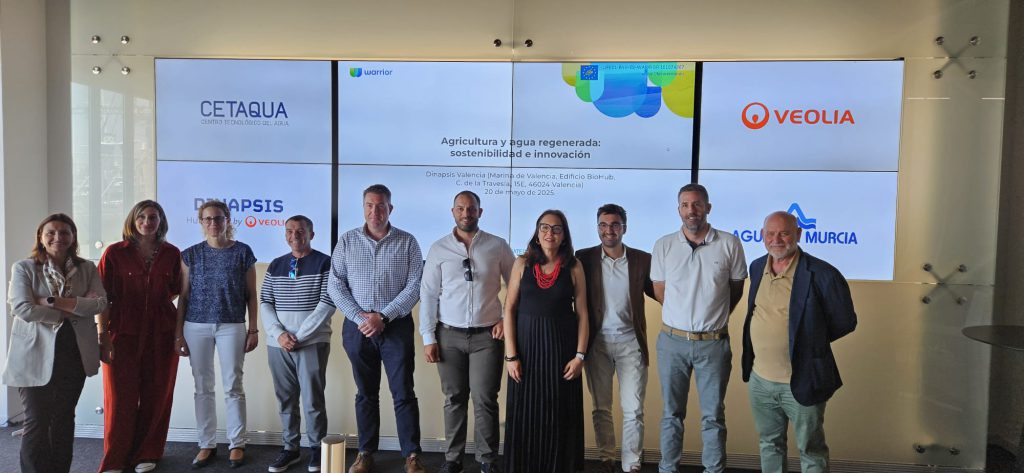
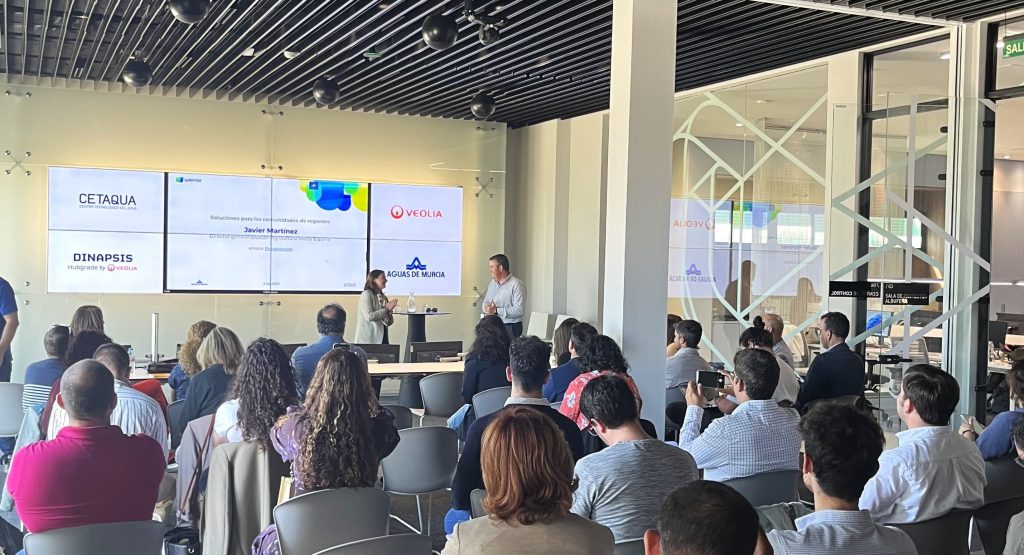
The Dinapsis Hubgrade facilities in Valencia hosted today the conference “Agriculture and reclaimed water: sustainability and innovation” within the framework of the development of LIFE WARRIOR, a project co-financed by the European Union’s LIFE programme and developed in collaboration between Cetaqua – Water Technology Centre, EMUASA – Empresa Municipal de Aguas y Saneamiento de Murcia and Aquatec, a technology company of Veolia Spain.
At the event, focused on analyzing the benefits of using reclaimed water in agriculture, all the details about LIFE WARRIOR were presented, whose objective is the development of an innovative water reclamation system through recycled ultrafiltration membranes. Thanks to this model, it is possible to produce water with the necessary quality requirements for its use in agricultural irrigation, as established by European regulations.
The director of Dinapsis, Cristina Baixauli, has emphasised that “our objective is to seek tools that can be scalable to all municipalities, which is why today we want to present the use case from the Murcia region, which allows us to test the technology and then implement it in the rest of the network”.
Baixauli has stressed that “this is a European project with a very clear objective: to promote the use of reclaimed water“. Furthermore, she has emphasised the importance of anticipating, adding that “our work consists of not having to wait until we have problems to seek solutions, but rather being proactive and prepared for phenomena such as drought“.
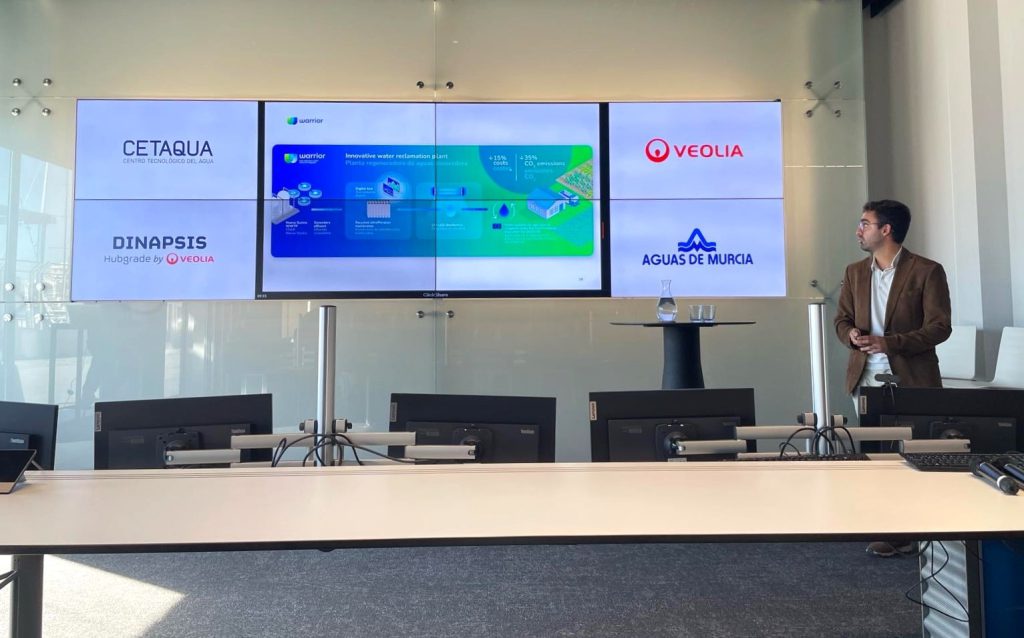
El evento ha contado con una ponencia impartida por Pau Berenguer, investigador en Cetaqua-Centro Tecnológico del Agua y coordinador del proyecto LIFE WARRIOR, quien ha compartido los resultados principales la operación de un tren de regeneración basado en membranas de ultrafiltración reutilizadas en la región de Murcia. Un territorio con escasez de agua y muy vinculado a la alta actividad agrícola, razones por las que Pau Berenguer apuntaba que “el aprovechamiento al máximo del recurso no es una opción, es una necesidad”.
The event featured a presentation by Pau Berenguer, researcher at Cetaqua-Water Technology Centre and coordinator of the LIFE WARRIOR project, who shared the main results of the operation of a reclamation train based on reused ultrafiltration membranes in the Murcia region. Pau Berenguer has highlighted that the territory’s water scarcity and its close connection to intensive agricultural activity mean that “maximising the use of this resource is not an option, it is a necessity”.
Similarly, emphasis was placed on the legislative framework for the use of reclaimed water for irrigation with a talk given by María Comes, Head of Technical Service of the Water Quality area of the Cuenca Hidrográfica del Júcar, who focused on current regulations, requirements and procedures for managing the authorisation to use reclaimed water.
In addition, Javier Martinez and Ignacio Gil, from Veolia Spain’s Agriculture division, explained the work they carry out in the search for sustainable and profitable solutions to support and advise agricultural producers and entrepreneurs, as well as farmers.
An example of this is the success story explained by Jose Antonio Pérez, president of the 4 Vegas irrigation community (Almería), about his experience in using reclaimed water.
Finally, Juan José Ajado, secretary of the Tormos irrigation canal community, and Maria Gurrea, head of environment and discharge control at Aigües de Paterna, held an interesting dialogue about the guarantees offered by reclaimed water.
The LIFE WARRIOR project stands out for its comprehensive approach and its strong commitment to sustainability. Through state-of-the-art technologies, it guarantees high quality reclaimed water, complying with the most recent European regulatory standards. This approach not only contributes to more efficient water resource management, but also aligns with the Sustainable Development Goals (SDGs) and the European Union’s guidelines on water reuse.
In addition to its positive environmental impact, the project represents a replicable model for other regions facing similar challenges in water management, positioning itself as a reference in the search for sustainable solutions to address the effects of climate change.
The pilot treatment train is designed to improve both the sustainability and efficiency of wastewater treatment. It consists of a combination of advanced technologies, including recycled ultrafiltration membranes (Re-UF) and a UV LED disinfection process, which stand out for being chemical-free and low energy consumption.