
News
– This European project is developing impact studies of natural disasters on critical infrastructures, as well as decision support tools, to improve their resilience
– ICARIA has brought together dozens of experts from the Barcelona metropolitan area, the Austrian region of Salzburg, and the Greek archipelago of the Southern Aegean to present and test the developed tools
Climate change is increasing the frequency, duration, and severity of extreme weather events. These phenomena have significant social and economic impacts, especially when they affect critical infrastructures in sectors such as water, energy, or transportation. To quantify and prevent the related damage, the ICARIA project is testing pioneering methods and digital tools developed during the project so that public administrations across Europe can address current and future climate challenges.
ICARIA aims to provide useful tools to quantify, predict, and improve resilience against phenomena such as droughts, heat waves, or floods, even considering that they might occur simultaneously or consecutively. `To ensure the usability of the tools, it is very important to involve experts from different sectors to co-create them.
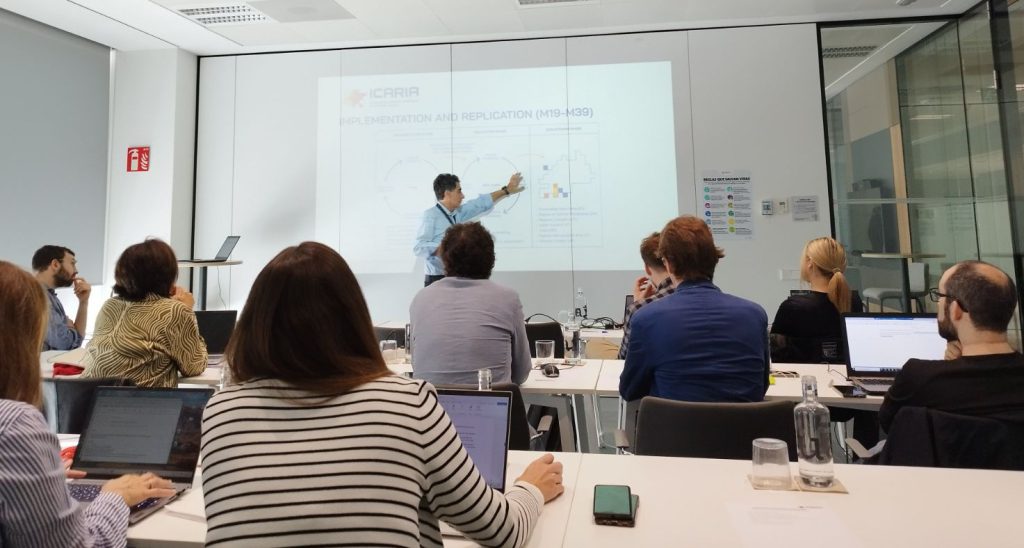
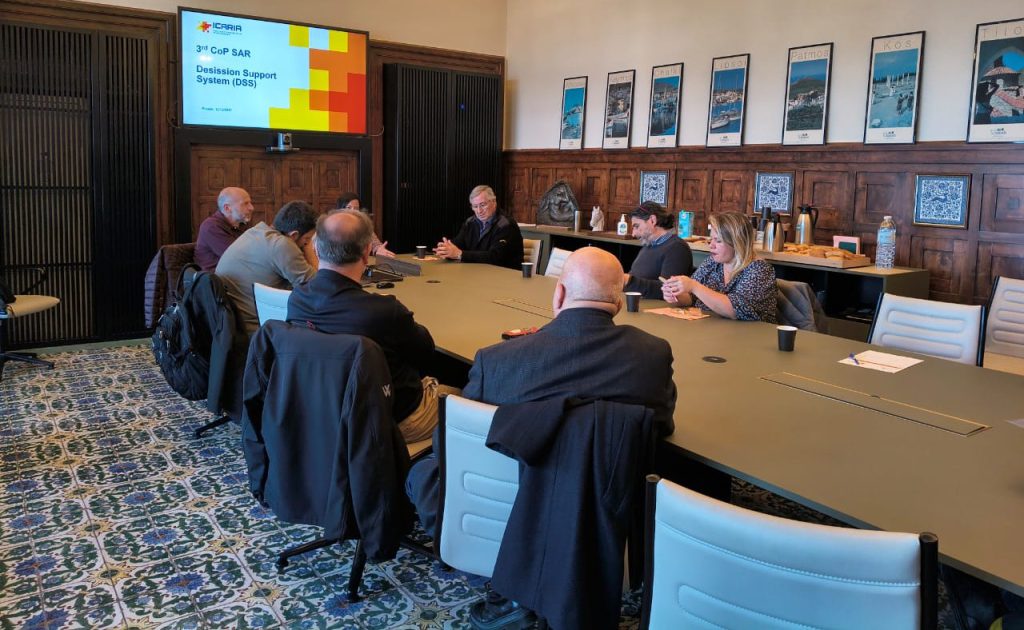
To this end, the ICARIA project has regional Communities of Practice that meet regularly and involve project partners and relevant stakeholders for the climate adaptation policies being implemented. In this context, professionals from sectors such as governments and regional agencies, public transport companies, and research centres from three European regions have participated in the pilot demonstration of simulation tools for risks derived from extreme climate phenomena, as well as decision support systems (DSS) developed in ICARIA.
The ICARIA project has three case studies with different characteristics that can be extrapolated to more European regions: the Barcelona metropolitan area, where urban flood models are being developed that will allow obtaining flood risk maps for all municipalities in the region under different climate change scenarios; the Austrian region of Salzburg, which focuses on developing risk maps of the impact of floods and windstorms on buildings and electrical infrastructures; and the Greek archipelago of the Southern Aegean, whose objective is to develop maps to address the effects of heat waves and fires on infrastructures such as ports, electrical systems and natural areas.
In addition, with the contributions from the three case studies, a free and accessible DSS is being developed targeting stakeholders involved in the development of climate policies. In this way, when the project is finished, the analyzed territories will have regional-scale climate and socioeconomic projections to understand the short and long term impact of the measures they take.
For Beniamino Russo, scientific coordinator of ICARIA, professor of Hydraulics and Hydrology at the Universitat Politècnica de Catalunya (UPC) and scientific advisor at Veolia in Spain, “the project will allow participating regions to understand the impacts derived from different extreme climate phenomena, including complex events such as compound or coinciding climate events, as well as their effects on strategic services and infrastructures. This knowledge will enable decision-making in advance on adaptation policies to improve the resilience of key assets in the different regions”.
He also emphasizes that “the designated tools are replicable, which will allow other European regions to use them as support systems to make their own decisions in climate adaptation policy”.
ICARIA is funded by the European Commission’s Horizon Europe program and has the mission of proposing a comprehensive framework for climate resilience and assessment of economic and social impacts. The members of its consortium have extensive experience in European research projects in the field of urban resilience and critical infrastructure management. Under the leadership of Veolia in Spain and the Universitat Politècnica de Catalunya, the project consortium is formed by the companies Aigües de Barcelona, Draxis Environmental from Greece and VERBUND from Austria; the Barcelona Metropolitan Area and the South Aegean Region of Greece as public entities; Cetaqua-Water Technology Center, the Foundation for Climate Research and the Catalonia Energy Research Institute (IREC) as Spanish research centers, the National Center for Scientific Research Demokritos and the National Center for Research and Technological Development of Greece, the National Laboratory for Civil Engineering of Portugal, and the Austrian Institute of Technology. From academia, the University of Naples Federico II and the University of Exeter from England participate.
ICARIA follows the footsteps of other previous initiatives, such as RESSCUE, a European research project led by Aquatec and completed in 2020. Unlike its predecessor, ICARIA focuses more specifically on the modeling and assessment of climate impacts on infrastructures of interest and their cascading effects at a regional scale, including simultaneous high-impact climate threats.
More information about the project on the ICARIA website.
The opinions and documentation provided in this publication are the sole responsibility of the author or authors, and do not necessarily reflect the views of the entities that financially support the project.