
News
– BioPhoto has developed technologies to produce, store, and purify green hydrogen through biological and chemical processes
– The hydrogen produced has valorised both liquid and solid organic waste from various industries
The BioPhoto project has concluded after demonstrating the feasibility of producing, storing, and purifying green hydrogen — a fully sustainable form of hydrogen that emits no polluting gases — from organic waste. Two different methods were tested to produce it: dark fermentation, a biological process, and photocatalysis, a chemical process.
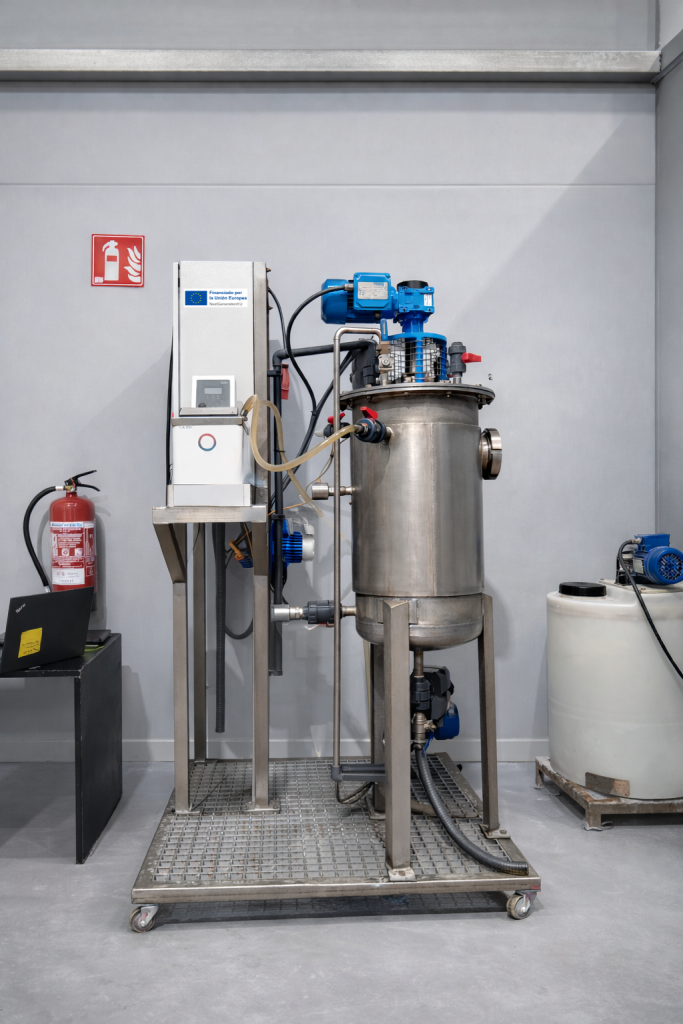
Dark fermentation, tested by Cetaqua-Water Technology Centre in its lab Cetaqua Lab&Tech, involves obtaining green hydrogen from organic waste in the absence of light through the action of anaerobic bacteria. Using this method, up to 60 litres of hydrogen per day were produced from starch-based waste.
On the other hand, photocatalysis, developed by CETIM, uses light to activate a material capable of breaking down organic compounds, making it possible to remove contaminants from water and air while producing hydrogen. Based on the best laboratory results obtained, a maximum potential production of up to 2.5 litres of hydrogen per day could be estimated from the effluent of dark fermentation, contributing to a more efficient and sustainable hydrogen production process.
Natalia Rey, Project Coordinator and Project Manager and Researcher at Cetaqua, explains: “The results of BioPhoto demonstrate the potential of organic waste as a resource for green hydrogen production, integrating different technologies into a circular and scalable solution. This solution enhances the entire value chain and contributes to the decarbonisation of the energy sector.”
Currently, hydrogen storage poses both logistical and economic challenges, as it requires significant space and involves high costs. Consequently, one of BioPhoto’s objectives was to develop new storage strategies.
To this end, CETIM has developed several methods for hydrogen storage, including those based on carbons derived from cellulosic biomass and those based on polyHIPEs, innovative materials that have achieved values comparable to commercial materials, positioning them as promising candidates for a range of applications.
In Spain, around 500,000 tonnes of hydrogen are consumed annually as an industrial feedstock across various sectors. This hydrogen is predominantly produced through natural gas reforming, which generates CO₂ emissions due to the use of this fossil fuel. Green or renewable hydrogen therefore stands out as an unparalleled solution for replacing fossil fuels in sectors that are hardest to decarbonise, contributing to the fight against climate change.
The BioPhoto project, funded by the European Union’s NextGenerationEU programme and led by Cetaqua with the participation of CETIM, Veolia and Orchestra Sci., is closely aligned with national and European objectives to achieve climate neutrality by 2050 (Net Zero Emissions 2050), as it promotes the energy and ecological transition.
Funded by the European Union – NextGenerationEU. However, the views and opinions expressed are solely those of the author(s) and do not necessarily reflect those of the European Union or the European Commission. Neither the European Union nor the European Commission can be held responsible for them.