News
– The solutions implemented in Santiago de Compostela have demonstrated the removal of up to 90% of pollutants present in urban runoff water
– The project concludes by consolidating key tools and lessons learned to support future blue-green infrastructure across Europe
The European project WATERUN is coming to an end after four years of developing innovative solutions to prevent and mitigate diffuse pollution —that is, pollution originating from multiple sources— caused by urban runoff water. Funded by the Horizon Europe programme, the project has worked in Santiago de Compostela (Spain), Aarhus (Denmark) and Amman (Jordan), combining innovative technologies, Nature-based Solutions (NbS) and co-creation processes with local stakeholders to advance towards more sustainable water management.
One of the project’s milestones has been the implementation and validation of demonstration units operating under real conditions. In Santiago de Compostela, Cetaqua – Water Technology Centre, in collaboration with Veolia, UDC and AIMEN, developed pilot NbS units and Sustainable Urban Drainage Systems (SuDS) in the Tambre and A Sionlla industrial areas, with the capacity to treat more than 10 m³ of water per day and reduce pollutants such as microplastics, hydrocarbons, heavy metals and suspended solids.
These solutions achieved removal rates of up to 90% for certain pollutants, contributing to the protection of environmentally valuable ecosystems such as the Sar and Sarela rivers, while demonstrating the potential of blue-green infrastructure —based on natural processes for water management— to improve urban resilience to climate change.
Sergio Santorio, Project Manager of the project and researcher at Cetaqua, highlights: “The results obtained demonstrate that NbS can improve the quality of urban runoff water. In addition, these are decentralised solutions with low operation and maintenance requirements that help improve flood management while providing additional environmental benefits.”
One of WATERUN’s distinguishing features has been its co-creation approach involving public administrations, industry, research centres and other stakeholders linked to urban water management. This process, led by SEECON, made it possible to integrate technical knowledge and real territorial needs into the development of the project’s solutions and tools.
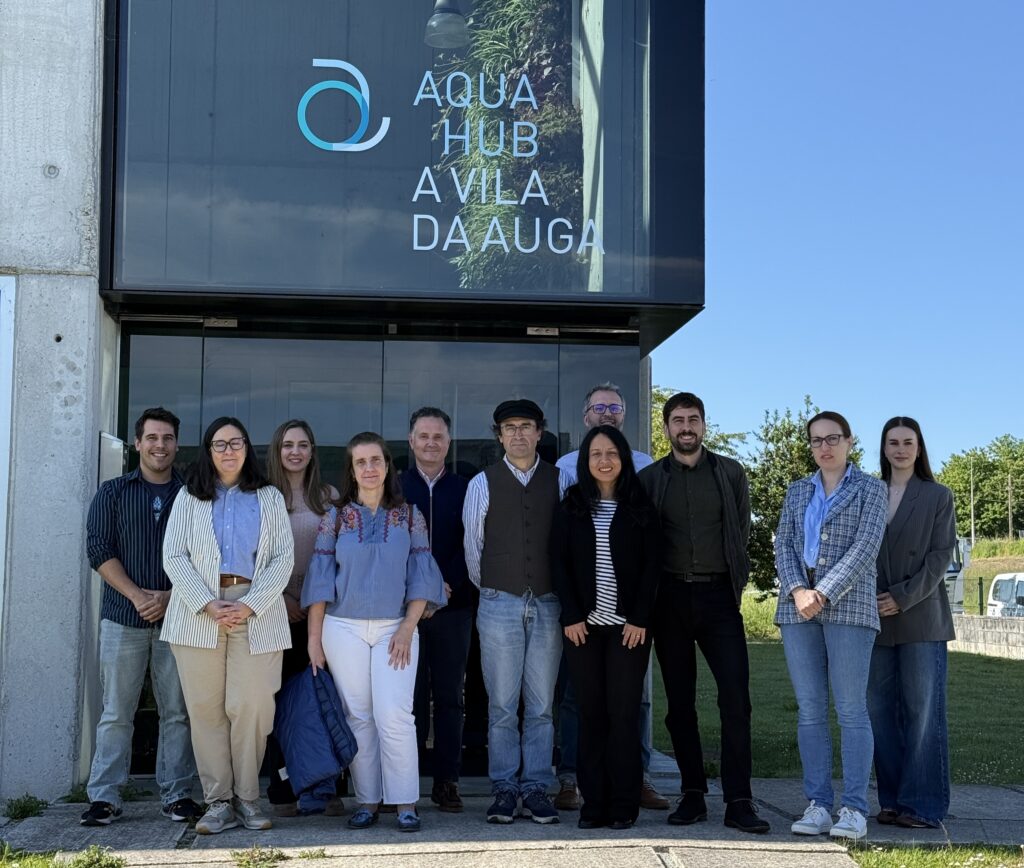
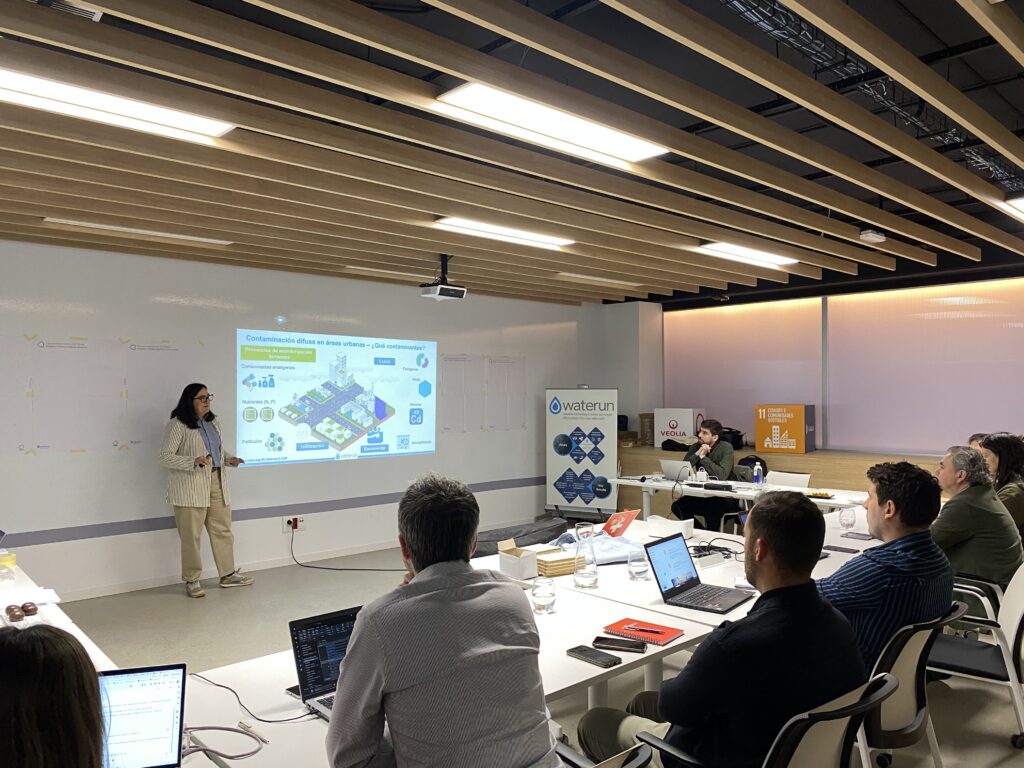
As the final step of this work, the project held the last meeting of its Co-Creation Committee in Santiago de Compostela, a collective reflection space aimed at consolidating the lessons learned during the four years of the project and transferring them to the design of future blue-green infrastructure.
During the session, representatives from public administration, research, industry and the water management sector analysed the progress achieved, identified challenges and opportunities for improvement for future projects, and jointly developed practical recommendations to facilitate the implementation of new NbS in urban environments.
These discussions directly reinforced the practical and territorial dimension of WATERUN’s results, highlighting that collaboration among different stakeholders is essential to develop technically, environmentally and socially sustainable solutions.
As part of its results, WATERUN developed tools aimed at supporting the planning and sustainable management of urban water. Among them is a practical guide compiling recommendations and lessons learned from the implementation of NbS in the project’s three case studies (Spain, Denmark and Jordan), supporting the future planning of blue-green infrastructure.
The project also developed a Decision Support System (DSS), enabling the simulation of urban runoff scenarios and the evaluation of different management strategies based on blue-green infrastructure.
Both tools were developed and validated together with relevant local stakeholders, ensuring their usefulness, usability and adaptation to real needs.
The results obtained across the three case studies demonstrate the potential of NbS and collaborative approaches to advance towards more sustainable and resilient cities. In this way, WATERUN contributes to supporting the implementation of the European Union Water Framework Directive and promoting urban strategies aligned with European climate adaptation and environmental protection goals.
WATERUN brings together an international consortium composed of AIMEN (coordinator), Veolia, Universidade da Coruña (UDC), Dublin City University (DCU), Technical University of Berlin (TUB), UFZ Helmholtz Centre for Environmental Research, Università Politécnica delle Marche (UNIVPM), Aarhus University (AU), TILIA GmbH, SEECON International GmbH, Office International de l’Eau (OIEAU), WAREG European Water Regulators, The University of Jordan (UJ) y Aarhus Vand (AV).
More information about the project is available on the WATERUN website.
WATERUN (2022–2026) has received funding from the European Union’s Horizon Europe research and innovation programme under grant agreement No. 101060922.
The views and documentation provided in this publication are the sole responsibility of the author(s) and do not necessarily reflect the views of the European Union.