News
– After treating waste from the olive oil industry for two years, the project’s pilot plant has moved to a new location to valorise waste from wine production
– The recovered polyphenols are a value-added product for the pharmaceutical, nutraceutical and cosmetics industries
The European LIFE CYCLOPS project has entered a new phase focused on valorising by-products generated during the winemaking process, such as grape pomace and lees produced during alcoholic fermentation, and recovering valuable compounds such as polyphenols.
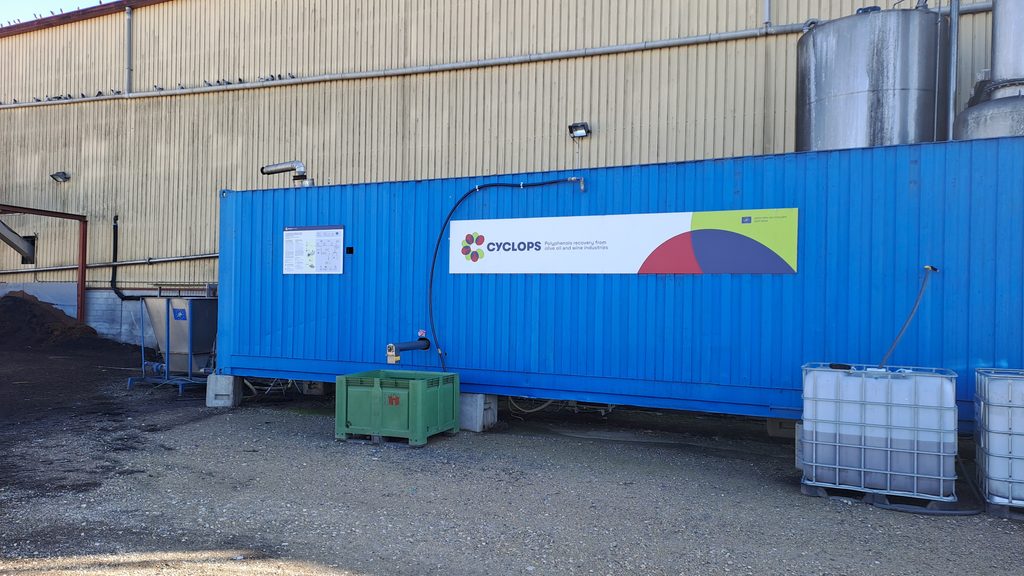
After two years treating by-products from the olive oil industry, such as olive pomace, first at the Capricho Andaluz olive mill, belonging to Borges International Group, in Cabra (Córdoba), and subsequently at Unió’s olive mill in Mont-roig del Camp (Tarragona), the pilot plant has recently been moved to one of the Grup Unió wineries in the Tarragona town of Vilalba dels Arcs.
At this new location, LIFE CYCLOPS will operate for six months to obtain polyphenols: compounds found in plants and plant-based foods that have antioxidant properties and positive effects on health, giving them significant value in sectors such as food, pharmaceuticals and cosmetics. This will demonstrate that the technology can be used in different agricultural industrial processes and easily transferred to different production plants.
The LIFE CYCLOPS solution: a commitment to zero waste
The CYCLOPS solution consists of three stages. First, solvents are added — water when treating waste from oil production, and water and ethanol when treating waste from wine production — together with agitation and heat, to extract the polyphenols from the waste. The resulting mixture then undergoes a solid–liquid extraction process, separating it into three different streams: an oily stream, an aqueous stream containing the polyphenols, and a solid stream. Finally, the aqueous stream is sent for purification through a membrane process comprising two stages — ultrafiltration and nanofiltration — producing an extract with a high concentration of polyphenols.
This pioneering technology enables agricultural industries to valorise waste whose treatment has a significant environmental, economic and logistical impact, while also recovering high-value-added compounds and promoting a circular economy and zero-waste model.
Furthermore, thanks to the extraction of polyphenols, the solid waste resulting from the process is suitable for the subsequent production of biogas through anaerobic digestion, as well as digestate — a nutrient-rich residual material generated through anaerobic digestion — for use as compost in agriculture.
In this regard, Albert Badell, Project Coordinator, Project Manager and researcher at Cetaqua, adds: “LIFE CYCLOPS not only recovers value through compounds such as polyphenols, but also offers an energy and agricultural outlet for the treated waste. It therefore provides a solution with the potential to replace the current treatment processes for by-products generated by the olive oil and wine industries in real-world settings.”
The project, co-funded by the European Commission’s LIFE Programme, will end in March 2027. It is led by Cetaqua, with the participation of Veolia, Borges-BAIEO, the CSIC, Unió Origen and Unió Nuts.
More information about LIFE CYCLOPS:
https://www.cetaqua.com/en/proyectos-destacados/life-cyclops-eu/
Co-funded by the European Union. The views and opinions expressed are solely those of the author(s) and do not necessarily reflect those of the European Union or CINEA. Neither the European Union nor the granting authority can be held responsible.