
News
– The European project LIFE MERLIN is developing a technology that will boost biogas production at the Monte Orgegia wastewater treatment plant (Aguas de Alicante) and Murcia Este wastewater treatment plant (Aguas de Murcia)
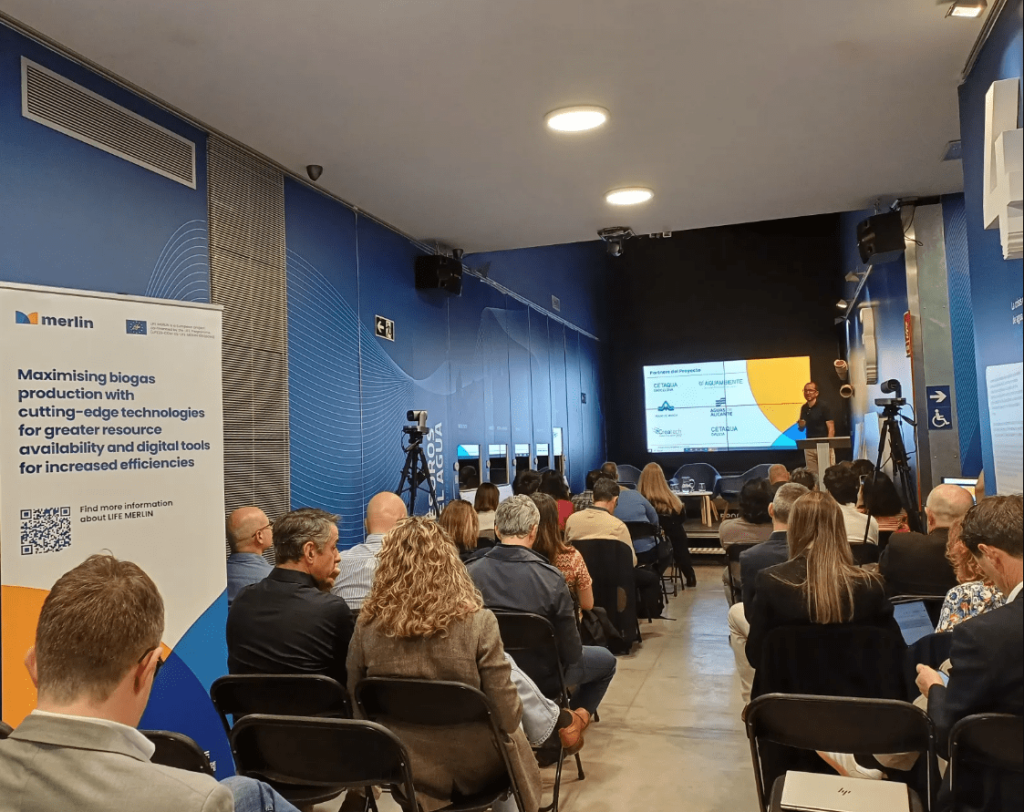
– LIFE MERLIN was presented this week at an event held at Museo de Aguas de Alicante that brought together wastewater treatment plant personnel, innovation specialists, the academic world, and engineering firms
Increasing electrical self-sufficiency is one of the challenges currently faced by wastewater treatment plants. To achieve this objective and thereby promote the sustainability of treatment facilities, the operators Aguas de Alicante (AMAEM) and Aguas de Murcia (EMUASA) are implementing an innovative technological solution in two of their wastewater treatment plants (WWTPs) through the European project LIFE MERLIN, coordinated by Cetaqua-Water Technology Centre, which was presented yesterday at a public event at Museo de Aguas de Alicante.
The MERLIN solution will combine the pretreatment of sludge from urban wastewater treatment with an anaerobic co-digestion process—that is, a digestion process of two or more raw materials—of waste from food industry companies, and will be optimized in real time thanks to digital solutions developed by Createch 360º. The pilots, located at the Monte Orgegia (Alicante) and Murcia Este (Murcia) WWTPs, will maximize biogas production that can subsequently be used as an energy source for the operation of the facilities themselves.
Marcel Vilaplana, researcher and Project Manager at Cetaqua-Water Technology Centre and project coordinator, states that “LIFE MERLIN will enable a 17% annual increase in renewable energy for self-consumption at Monte Orgegia and Murcia Este.“
During the LIFE MERLIN presentation event, Cetaqua-Water Technology Centre, project leader, presented together with AMAEM, EMUASA and Createch 360º, all members of the project consortium, the advantages of this solution, which represents a step forward in anaerobic digestion processes already existing in some wastewater treatment plants because it allows for a significant increase in biogas production and improves the economic efficiency of the process.
For Iñaki Casals, Innovation Director at Aguas de Alicante, “the technological solutions we will implement in LIFE MERLIN will increase green energy generation in Alicante’s wastewater treatment plants in the near future, in line with our objective of transforming treatment plants into eco-factories. The environmental and operational impact of this innovation will become a reality in the short term.” Along these lines, Miguel Ángel González, Operations Director at Minera Los Frailes, states that “this is an exemplary project with great application potential that has managed to recover valuable by-products and, at the same time, add value to old mining sites, creating a significant positive impact at both economic and environmental levels.”
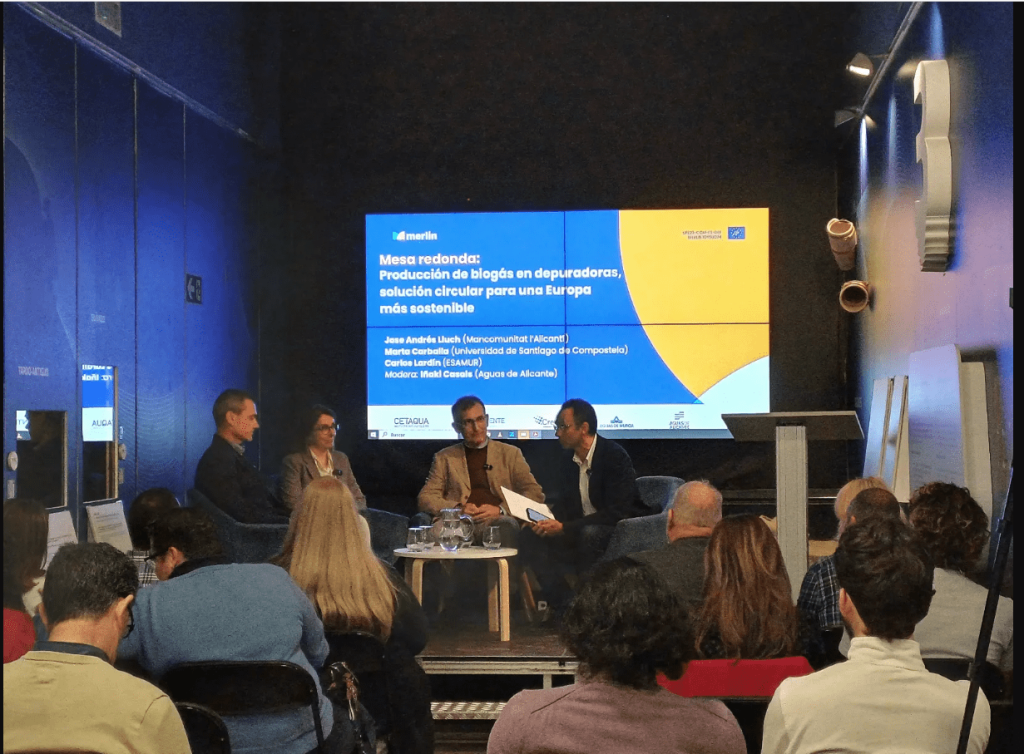
The event also included a round table with Jose Andrés Lluch, Technical Director of Mancomunitat l’Alacantí, Marta Carballa, Associate Professor at the Department of Chemical Engineering of the University of Santiago de Compostela, and Carlos Lardín, Head of Operations for Zone II of the ESAMUR Entity. In the panel, moderated by Iñaki Casals, the three experts were able to discuss topics related to the improvement of sludge digestion processes in WWTPs and the need to integrate scientific knowledge into real processes.
Although the LIFE MERLIN project, co-financed by the European Commission, has a duration of four years, it is expected that, once the project is completed, the developed solution can be replicated in six other treatment plants throughout Spain.
In addition to contributing to the decarbonization of processes in different wastewater treatment plants, the LIFE MERLIN project will promote the valorization of sewage sludge and industrial waste through the anaerobic co-digestion process, thus promoting a circular economy solution and contributing to a more environmentally sustainable territory.
Ultimately, LIFE MERLIN will contribute significantly to achieving the objectives of the European Renewable Energy Directive (2018/2001/EU), which establishes that 42.5% of the energy produced in Europe should be renewable by 2030.
The views expressed are solely those of the author(s) and do not necessarily reflect those of the European Union or the European Health and Digital Executive Agency (HADEA). Neither the European Union nor the granting authority can be held responsible for them.