
News
– The European ICARIA project has developed flood maps that indicate that the risk to people, vehicles and infrastructure could increase due to climate change
– ICARIA has also produced studies to quantify the impacts of extreme weather events on homes and infrastructure such as roads or electricity networks in other European regions.
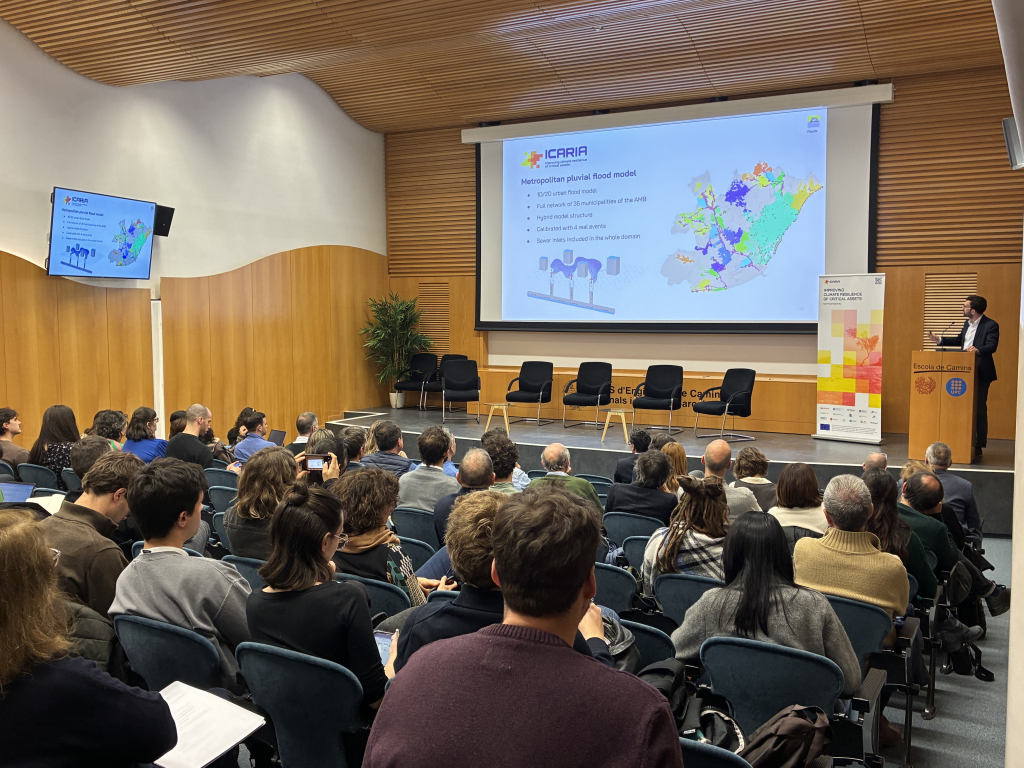
New flood risk maps developed within the European ICARIA project provide insights into how climate change could influence pluvial flooding in the Barcelona metropolitan region over the coming decades, helping cities better anticipate and adapt to extreme weather events. According to these maps, areas vulnerable to severe pluvial flooding in the Barcelona metropolitan area could grow by up to 25% over the next 75 years as a consequence of climate change if adaptive measures are not taken.
Beniamino Russo, Scientific Coordinator of ICARIA, Professor of Hydraulics and Hydrology at the School of Civil Engineering of the Universitat Politècnica de Catalunya – BarcelonaTech (UPC), and Scientific Advisor for Veolia in Spain, states that “thanks to the risk maps developed during the project, we can know which towns, neighborhoods, and even streets could be most affected by heavy rains under different climate change scenarios and the existence or absence of adaptation measures.”
In addition to the case of Barcelona, the project has also carried out studies in the European regions of Salzburg (Austria) and the South Aegean Islands (Greece) to quantify the impact of extreme weather events such as heatwaves, floods, coastal storms, extreme winds, or fires on housing and critical infrastructure, such as roads or power grids. Thus, the three case studies feature distinct scenarios that can be extrapolated to more European regions.
The ICARIA project, led by Veolia in Spain and the UPC, has been carried out for over three years with the collaboration of 14 other European partners, including Cetaqua – Water Technology Centre, Aigües de Barcelona, and the Barcelona Metropolitan Area (AMB). Its objective is to provide useful tools to quantify, forecast, and improve resilience against extreme climate events. These events often occur simultaneously or consecutively, which is why they must be addressed holistically.
In this regard, Russo adds an example from the Barcelona metropolitan region: “we have studied that when a heavy rainfall event coincides with a sea storm, as happened during Storm Gloria, this worsens drainage into the sea and increases flooding in coastal areas compared to isolated rainfall events.”
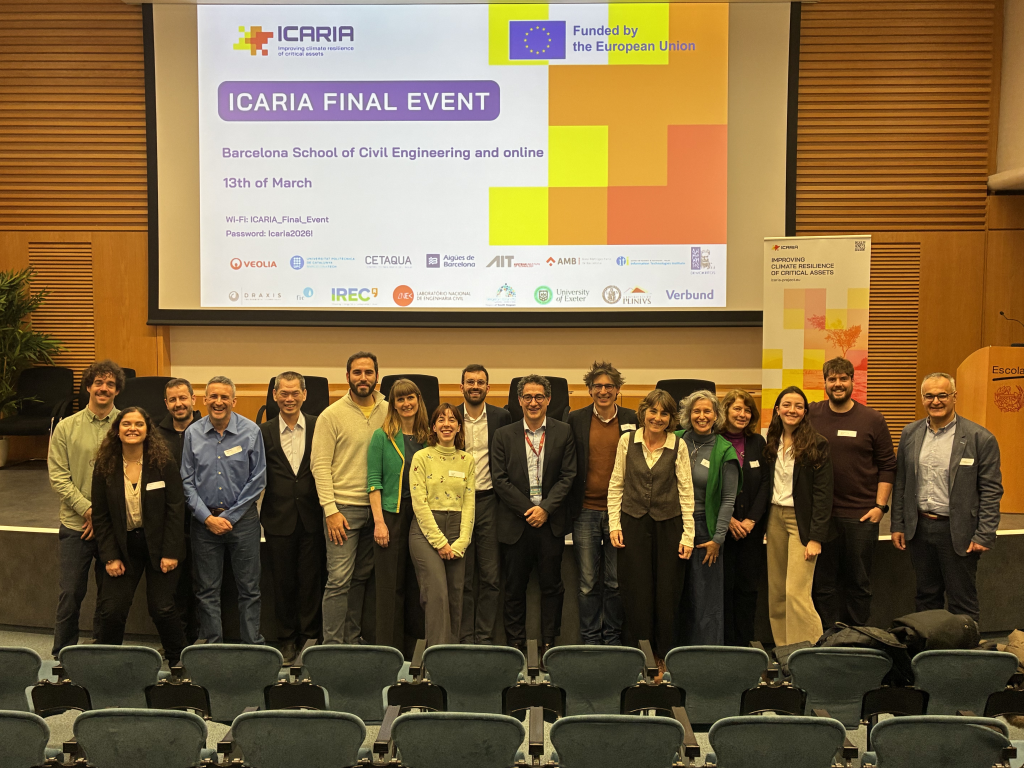
During the final ICARIA event, held last Friday at the Barcelona School of Civil Engineering of the UPC, the leaders of the three case studies shared the project’s main conclusions, solutions, and tools with over 150 professionals from fields such as public administration, the water sector, energy, and meteorology. Among these, a free and accessible decision support system (DSS) for all stakeholders involved in the development of climate policies stands out.
Ana Romero, Director of Climate Action Services at the AMB, highlights: “Within ICARIA, we have worked very closely with relevant stakeholders in the climate policies of each region through Communities of Practice. Thanks to this collaboration, we have been able to learn about and contribute to the development of the tools from the beginning, and we have ensured that they are useful to us when making decisions on adaptation policies in advance.”
Some adaptation measures proposed within the framework of ICARIA to reduce the effects of extreme rainfall are sustainable drainage systems such as “green” roofs, porous pavements, and bioretention areas in urban spaces for water retention and infiltration. The tools designed and solutions proposed during ICARIA have been intended to be replicable, which will allow other European regions to use them in their climate adaptation policies.
The ICARIA project has been funded by the Horizon Europe programme. In addition to the previously mentioned partners, its consortium is made up of Draxis Environmental, VERBUND, the South Aegean Region of Greece, the Climate Research Foundation, the Catalonia Institute for Energy Research, the National Centre for Scientific Research Demokritos, the National Centre for Research and Technological Development, the National Laboratory for Civil Engineering, the Austrian Institute of Technology, the University of Naples Federico II, and the University of Exeter.
More information about the project is available on the ICARIA website.
The opinions and documentation provided in this publication are the sole responsibility of the author or authors and do not necessarily reflect the views of the European Union.