
News
– This European project has validated five technologies to develop a new generation of sustainable fertilisers based on nutrient recovery
– Through five pilot plants, WalNUT has established itself as a key circular agriculture solution to reduce Europe’s dependence on mineral fertilisers
The WalNUT project, funded by the Horizon 2020 programme, was launched four and a half years ago with a clear mission: to respond to the growing pressure on the global food system. Population growth and increasingly demanding consumption patterns are forcing agricultural production to intensify, multiplying the use of land, water, energy and fertilisers, and significantly increasing the demand for crop nutrients. In addition, soils — a limited and irreplaceable resource — are under threat from practices that generate nutrient surpluses or deficits at territorial scale.
To address this scenario, WalNUT proposed redesigning nutrient supply chains by recovering nutrients from wastewater and brines and transforming them into biofertilisers.
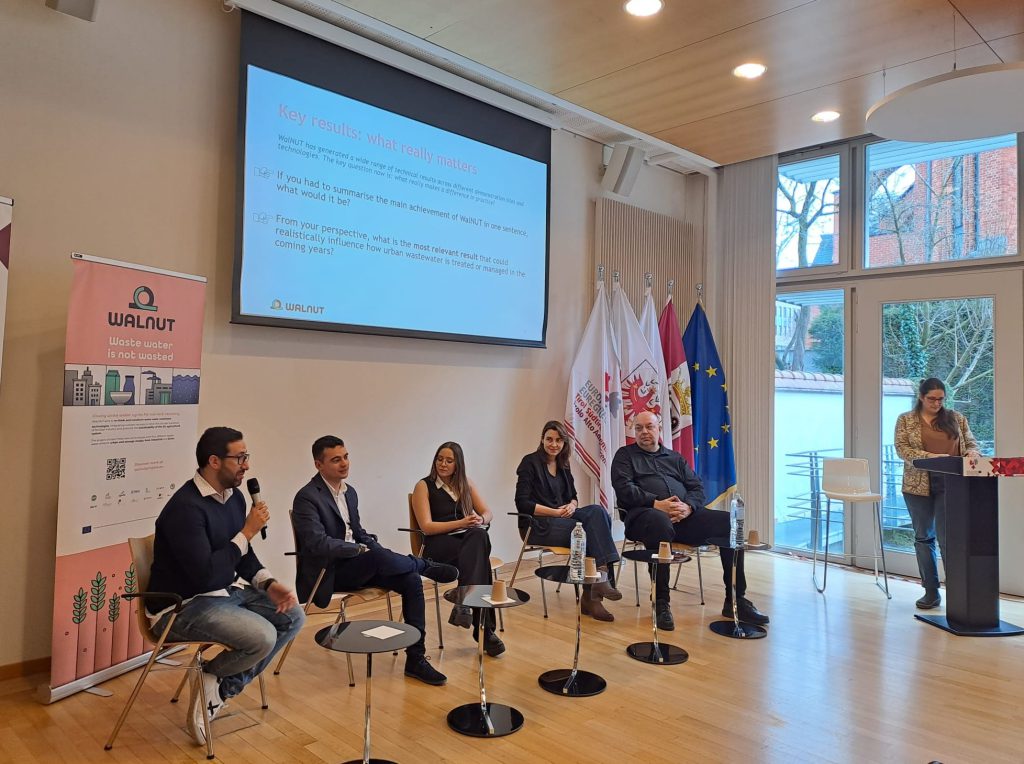
Last week, the project’s final event was held in Brussels to present the main results and milestones achieved over these years of work. These include the validation of five technologies tested in five pilot plants located in Spain, Belgium, Hungary and Greece. Each technology is designed to recover nutrients from a different source: industrial wastewater, urban wastewater, food industry residues, brines and the sludge line of wastewater treatment plants.
Cetaqua has led the development of a technology to treat sludge resulting from the wastewater treatment process and recover nitrogen. This technology has been implemented and validated in a pilot operating under real conditions at the Ourense wastewater treatment plant (WWTP), operated by Veolia.
The technology consists of a treatment train for reject water — water streams containing fine suspended sediments — generated during the treatment process. These streams have high levels of soluble nitrogen, whose conventional treatment is energetically costly.
The alternative treatment proposed by Cetaqua recovers this nitrogen for use as a fertiliser product through a process in which the residual stream is first conditioned, concentrating the nitrogen present in the water using an ion exchange column, and it is then extracted free of contaminants through hollow-fibre membrane contactors, producing ammonium sulphate.
In addition, during the project, the production of fertilisers from struvite and plant growth-promoting bacteria has also been explored.
Alicia González, Project Manager and researcher at Cetaqua, highlights that “the project results have been very promising: not only has the treatment train been successfully validated at a technological level, but sufficient fertiliser (based on ammonium sulphate and struvite) has been produced with environmental safety and proven effectiveness”.
According to González, WalNUT also represents a starting point for the future: “the journey continues, with key challenges ahead such as optimising yields or automating the process. All of this opens up an exciting phase to consolidate this solution and maximise its real impact on the territory”.
By recovering nutrients from wastewater, WalNUT helps reduce Europe’s dependence on mineral resources from outside the EU and minimises the environmental impact of conventional production and extraction methods. In this way, WalNUT offers a strategic and sustainable alternative that strengthens European autonomy in the agri-food sector by reducing the risks associated with the depletion of natural resources.
Thus, WalNUT comes to an end, but its impact and results will continue to transform the future of agriculture, nutrient recovery and circular water management.
Find out more information about the project on its website.
The WalNUT consortium is made up of 14 entities: CARTIF (coordinator), Assemblée permanente des Chambres d’agriculture, AQUAFIN, CETAQUA, 3R-BioPhosphate Ltd., UGENT, ICONS, NTUA, University of Southern Denmark, University of Copenhagen, AGROINNOVA, VEOLIA, University of Coimbra, Agrarian Technological Institute of Castile and León.
The opinions and documentation provided in this publication are the sole responsibility of the author(s) and do not necessarily reflect the views of the entities that financially support the project.